
Move Credit Card Debt Into One Fixed Payment
A $7,000 example, using the latest Federal Reserve rates, shows how a personal loan can lower interest, shorten payoff, or free up monthly cash.
Written by Eric Barba
Reviewed by a licensed loan officer on our team · Published Oct 30, 2026 · 7 min read
Personal loans carry lower interest than credit cards, and that can help you reach your goals faster.
Why card debt is hard to pay off
A credit card has no end date, so the debt can follow you for years. When you pay only the minimum, interest gets added each month and the balance barely moves. At a high rate, most of every payment goes to interest instead of the debt itself.
A personal loan works in a different way, because it has a fixed rate, a fixed monthly payment, and a payoff date. Every payment you make brings the balance down, and you can see exactly when the debt will end.
The gap between card and loan rates is near a record
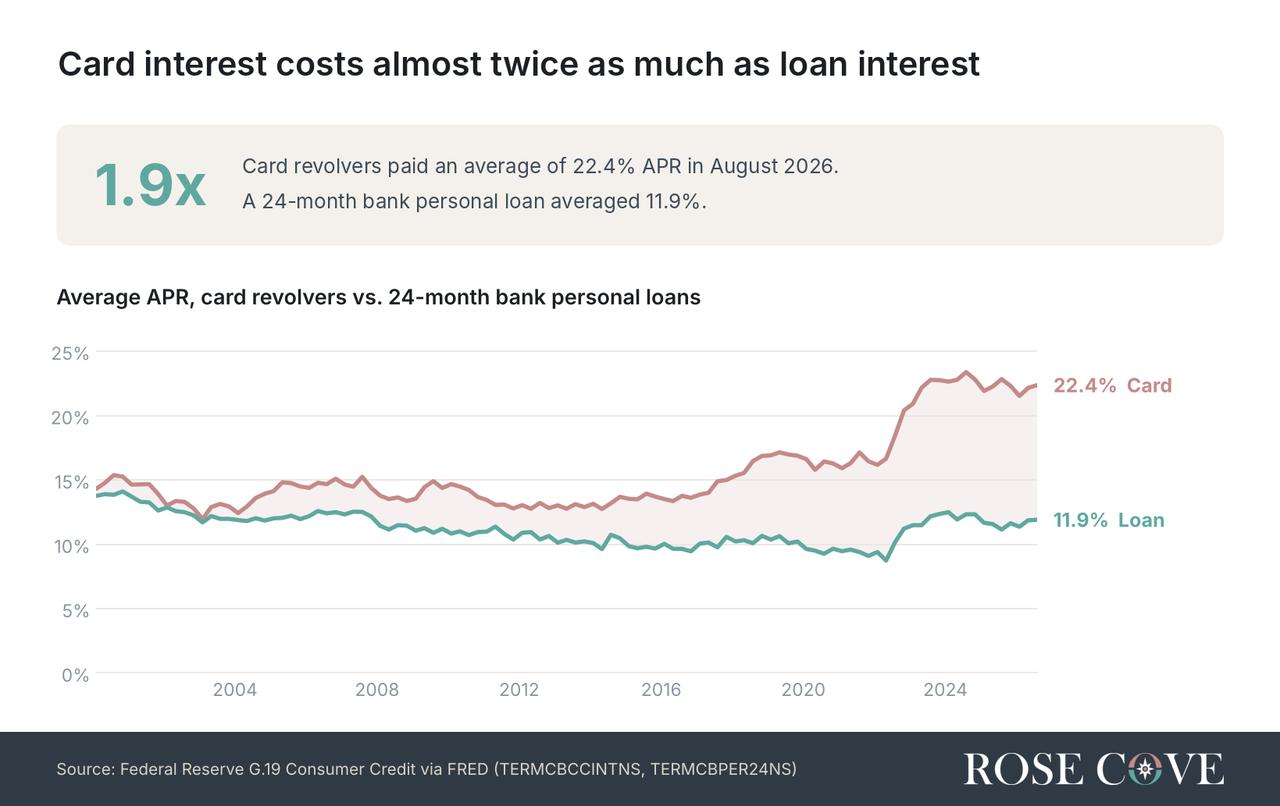
People who carry a card balance paid an average of 22.36% Annual Percentage Rate (APR) in August 2026, according to the Federal Reserve. The average 24-month personal loan at a bank costs 11.90% APR. That is a significant gap.
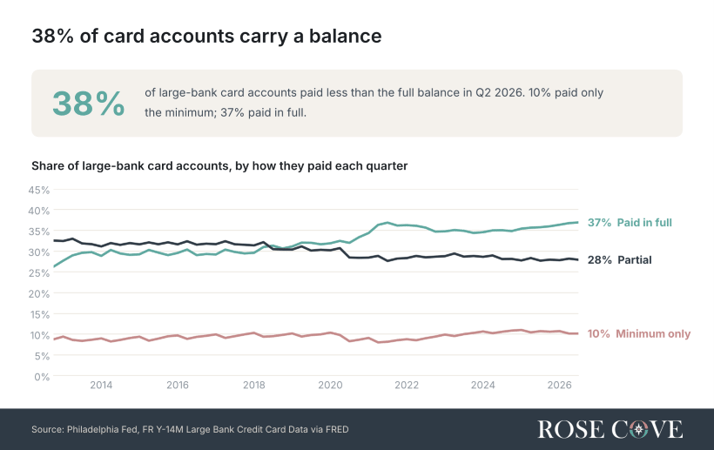
You are not alone. Americans owe $1.35 trillion in revolving credit. In the second quarter of 2026, about 38% of card accounts at large banks paid only part of their balance, and about 1 in 10 paid only the minimum.
A simple example with real numbers
Say you owe $7,000 across your credit cards. That is close to the $6,610 average card debt per borrower that TransUnion reported for the second quarter of 2026. Your card charges 22.36% APR, the average rate card revolvers paid in August 2026. A personal loan offers 11.90% APR, the average for a 24-month bank loan. Your own rates will be different, and loan rates rise as credit scores fall, but the idea works the same way.
Month one: the card adds $130 in interest, while the loan adds only $69. That is $61 saved in the first month on the very same balance.
Now look at three paths that each start with the same $7,000 of debt. In Path 1, you keep the card and pay $200 a month, about your first minimum payment. In Paths 2 and 3, you move the debt to a 48-month personal loan.
| Path | 1. Stay the course (22.36% APR) | 2. Move to a loan (11.90% APR) | 3. Move to a loan & keep your payment |
|---|---|---|---|
| Monthly payment | $200 | $184 | $200 |
| Time to pay off | 58 months | 48 months | 44 months |
| Total interest | $4,440 | $1,832 | $1,640 |
Path 1: Staying the course costs $4,440 in interest
You keep your $7,000 on the card and pay $200 a month. That is about your first minimum payment: 1% of $7,000 is $70, plus $130 in interest.
At 22.36% APR, it takes 58 months to pay off the debt. You pay $4,440 in interest on top of the $7,000.
This is not financial progress. In the first year, you pay $2,400, but $1,474 of it goes to interest. After 12 payments, you still owe $6,074.
Real card minimums shrink as your balance falls, so the debt lasts even longer. A minimum of 1% of the balance plus interest, never less than $25, would take about 22 years and cost about $12,000 in interest.
Path 2: A personal loan cuts your interest to $1,832
Now use a personal loan to pay off the card. At 11.90% APR, a 48-month loan has a fixed payment of $184 a month.
You pay $1,832 in interest, which is $2,608 less than Path 1. Your payment is $16 lower, and you finish 10 months sooner. Unlike a card, the loan has a payoff date from the first day.
We chose 48 months for this example. A shorter loan has a higher payment but costs less in interest.
Path 3: Keeping your $200 payment ends the debt 14 months sooner
Path 2 frees up $16 a month. Put it to work. Keep paying the same $200 you paid on the card. The extra $16 goes straight to the principal, which is the amount you borrowed. A lower balance means less interest each month.
Look at month one. On the card, your $200 pays $130 in interest and only $70 of the debt. On the loan, the same $200 pays $69 in interest and $131 of the debt.
You pay off the loan in 44 months and pay $1,640 in interest. Next to Path 1, you finish 14 months sooner and keep $2,800. Next to Path 2, you finish 4 months sooner and keep $192.
The real takeaway: you make the same payment you make today, but more of it goes to the debt, and the debt ends on a date you can see.
The one rule that matters
This strategy only works if you stop adding new spending to the cards. If the cards fill up again, you will owe the loan payment and the card balances at the same time. Keep the cards open if you like, but treat them as paid off.
How to make the move
- List each card with its balance and its APR so you know exactly what you owe.
- Check loan rates, since many lenders let you see an estimated rate without a hard credit check.
- Weigh the APR, not just the interest rate, because the APR includes fees such as an origination fee.
- Use the loan to pay off the cards, and ask whether the lender can send the money directly to your card companies.
- Set up automatic payments so every payment arrives on time.
The bottom line
Moving card debt into a fixed payment will not fit every situation. For people who carry a balance every month, though, a lower rate and a clear end date can turn years of costly interest into a plan that you can actually finish. Keep making the payment you already make, and the savings go straight to paying off the debt sooner.
How we did the math
You can check every number on this page. Here are the steps.
| Step | Path 1 | Path 2 | Path 3 |
|---|---|---|---|
| Starting balance | $7,000 | $7,000 | $7,000 |
| APR | 22.36% | 11.90% | 11.90% |
| Monthly rate (APR ÷ 12) | 1.863% | 0.992% | 0.992% |
| Month-one interest (balance × monthly rate) | $130.43 | $69.42 | $69.42 |
| Monthly payment | $200 | $183.99 | $200 |
| Number of payments | 58 | 48 | 44 |
| Total paid | $11,440 | $8,832 | $8,640 |
| Total interest (total paid − $7,000) | $4,440 | $1,832 | $1,640 |
Path 1 payment. The first minimum is 1% of $7,000 plus one month of interest: $70 + $130.43 = $200.43. We round to $200 and hold it steady.
Path 1 payoff. Each month, the interest is your balance times 1.863%. Your payment covers that first, and the rest lowers the balance. After 57 payments of $200, a final payment of $40.44 clears the debt. That is $11,440.44 in all.
Path 2 payment. A fixed loan payment comes from this formula: balance × monthly rate ÷ (1 − (1 + monthly rate)−months). With $7,000, a 0.992% monthly rate, and 48 months, the payment is $183.99. Times 48 payments, that is $8,831.52.
Path 3 payoff. We follow the same month-by-month steps on the loan with a $200 payment. After 43 payments of $200, a final payment of $40.48 clears the debt. That is $8,640.48 in all.
Rounding. Totals are rounded to the whole dollar, and the differences on this page use those rounded totals. We assume a fixed rate, payments at the end of each month, and no fees. A lender may adjust your last payment by a few cents.