
Nearly 3 in 4 have paid a price for putting off money tasks. Most aren’t sure how much.
6 in 10 people putting off a money task say it feels overwhelming. Most of those tasks would take an afternoon or less.
Written by the Rose Cove editorial team
Published Nov 11, 2026 · 8 min read
Key takeaways
- 74% have paid a price for putting off a money task. Yet 59% aren’t sure what it has cost them.
- 60% of people putting off a money task say it feels overwhelming. This is more than twice the 28% who say they’re too busy.
- 72% say their most avoided task would take an afternoon or less. A quarter of them have put it off for more than a year.
- 1 in 3 (33%) would rather clean the bathroom than check their credit card balance. Some would even rather sit in traffic for an hour (16%) or go to the dentist (15%).
- 30% of people putting off a money task would hand their most dreaded one to AI. Among those who aren’t putting one off, just 8% would.
For most people who are putting off a money task, time isn't the problem. Feeling overwhelmed is. We surveyed 1,009 U.S. adults about the money tasks on their someday list. We asked how long they've waited, why they avoid them, what it has cost them, and what finally gets them to act. Then we compared what they said with what their other answers show.
The answers point to one need: a clear next step that makes money tasks feel smaller.
Money tasks get stuck because they feel overwhelming, not because people are busy.
Most people have a money task on hold. 82% are putting off at least one right now, and the average person is avoiding more than two.
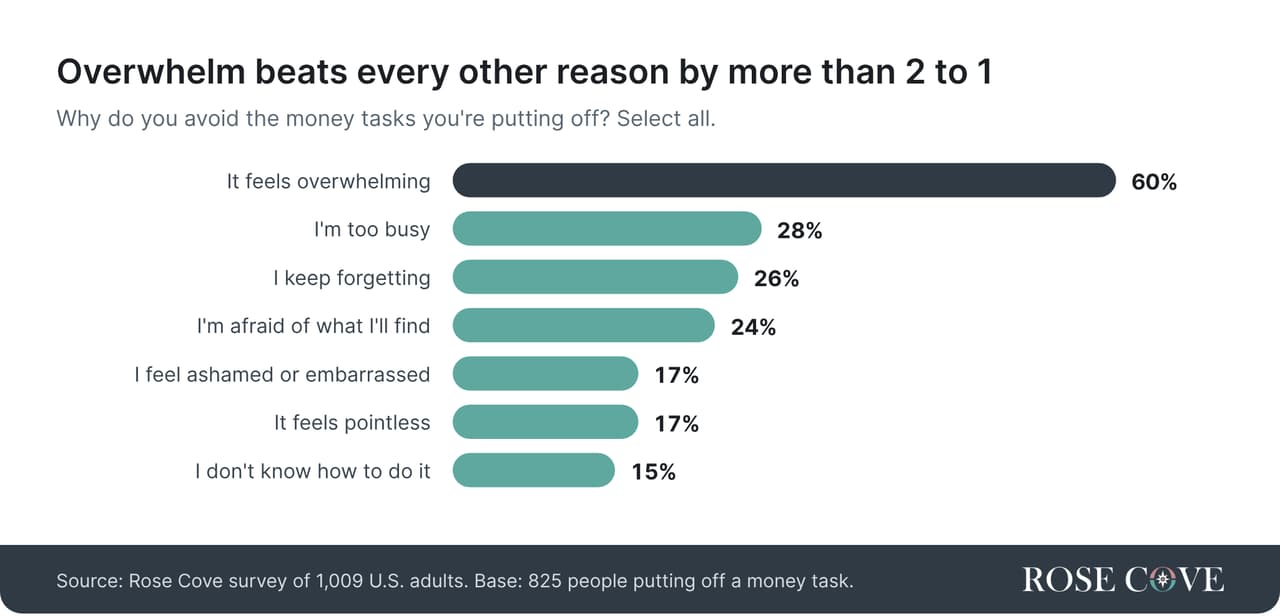
60% of people putting off a money task say it feels overwhelming. That is more than twice any other reason. Only 28% say they're too busy.
Fear plays a part too. 40% have avoided checking their bank account because they feared they couldn't cover an upcoming expense. Most of them describe it as overwhelm, not fear. Among people who avoided their account out of fear and are putting off a task, 71% said it feels overwhelming. 35% said they were afraid of what they'd find.
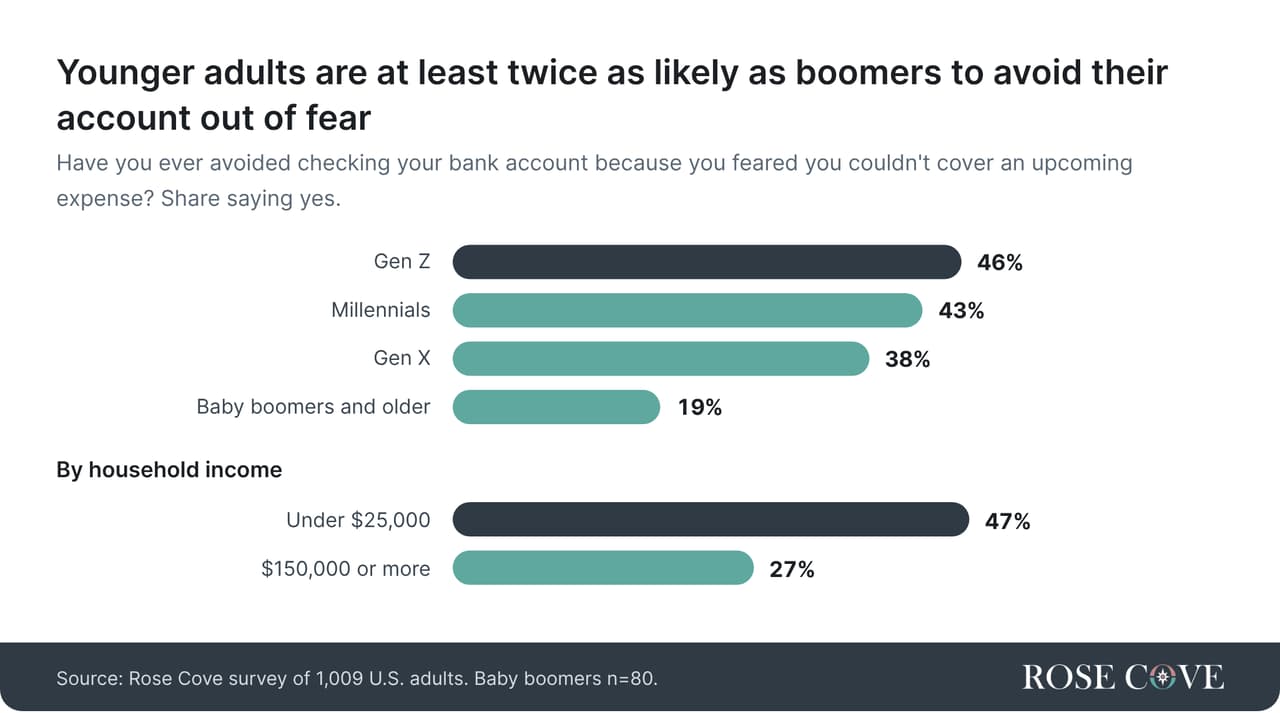
Income eases the fear but not the overwhelm. 47% of people in households earning under $25,000 have avoided their account out of fear, compared with 27% of those earning $150,000 or more. Yet about 6 in 10 people who are putting off a task feel overwhelmed across all income bands, and 71% of the highest earners are putting off a money task right now.
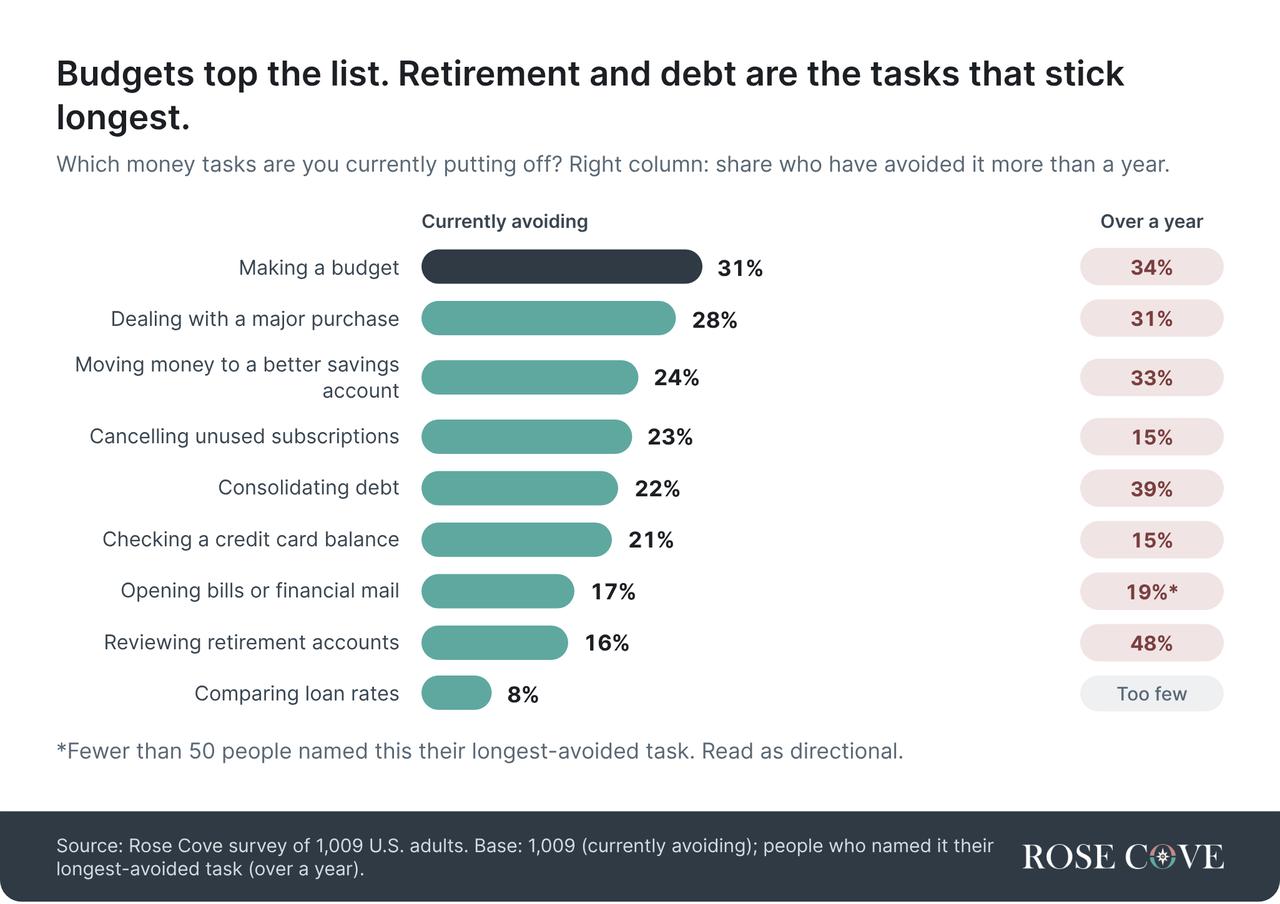
About 1 in 3 people putting off a money task (31%) have been dodging it for more than a year. Millennials are more likely than Gen Z to be stuck that long (33% vs. 23%).
Checking a balance can feel worse than a chore. 1 in 3 (33%) would rather clean the bathroom than check their credit card balance. Some would rather:
- Sit in traffic for an hour (16%)
- Go to the dentist (15%)
- Do their taxes (11%)
- Call an ex (5%)
Nearly 3 in 4 have paid for putting off money tasks. Most can't say how much.
Unopened mail and unfinished forms don't always stay harmless. Left alone, they can turn into penalties, missed money, and credit damage.
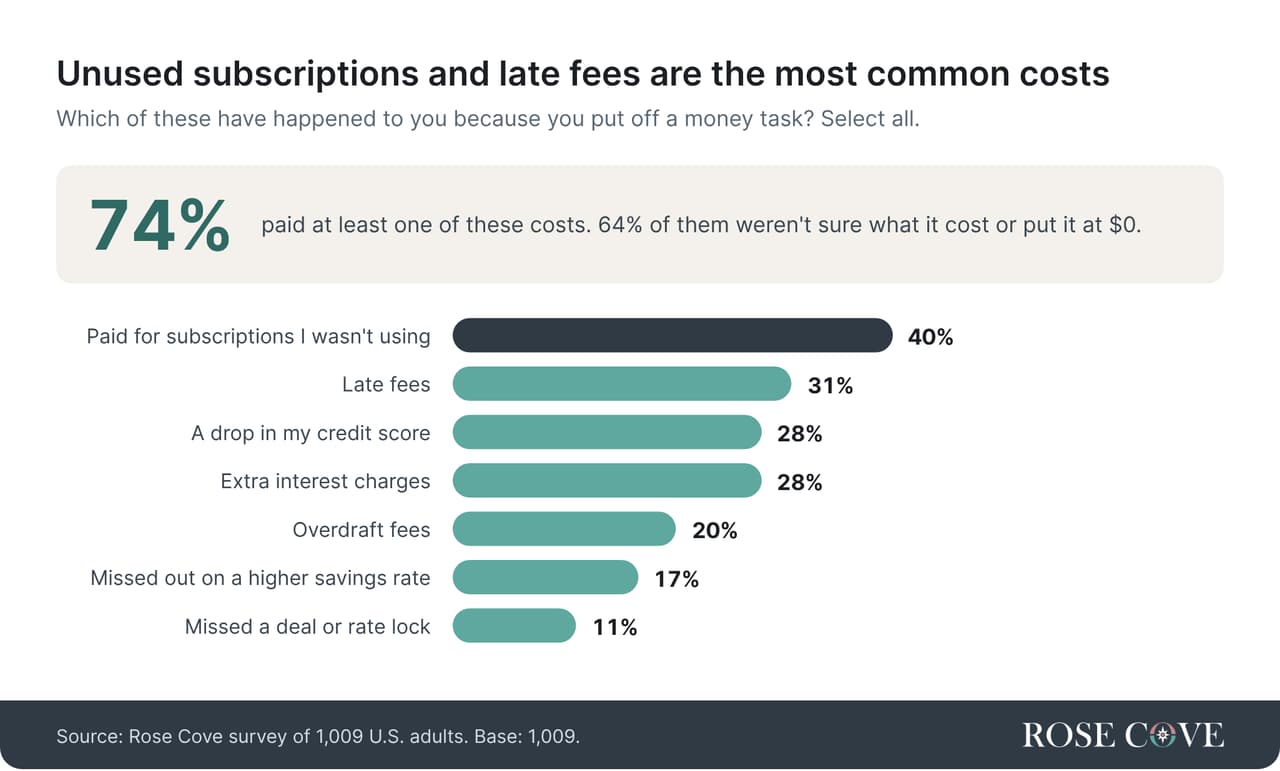
Putting off money tasks has a price, even when nobody adds it up. 74% have paid for it through late fees, overdraft fees, extra interest, a missed rate or deal, or subscriptions they weren't using. Yet 59% aren't sure what putting off money tasks has cost them.
When people can name the cost, it is often large. Among those who put a number on it, 1 in 4 said $500 or more in the past year. Across everyone, 1 in 10 named $500 or more, and 6% named $1,000 or more.
Unopened bills turn into penalties. 35% have waited so long to open a bill that it was too late to dispute it or avoid a penalty. Baby boomers are the exception: 10% have let a bill go that long, compared with 33% to 39% of younger generations.
Missed paperwork means missed money. 40% have missed a refund, rebate, or other benefit because they didn't complete the paperwork on time. Gen X (44%) and millennials (42%) miss out most often, compared with 34% of Gen Z and 29% of baby boomers.
Debt is where avoidance hurts most.
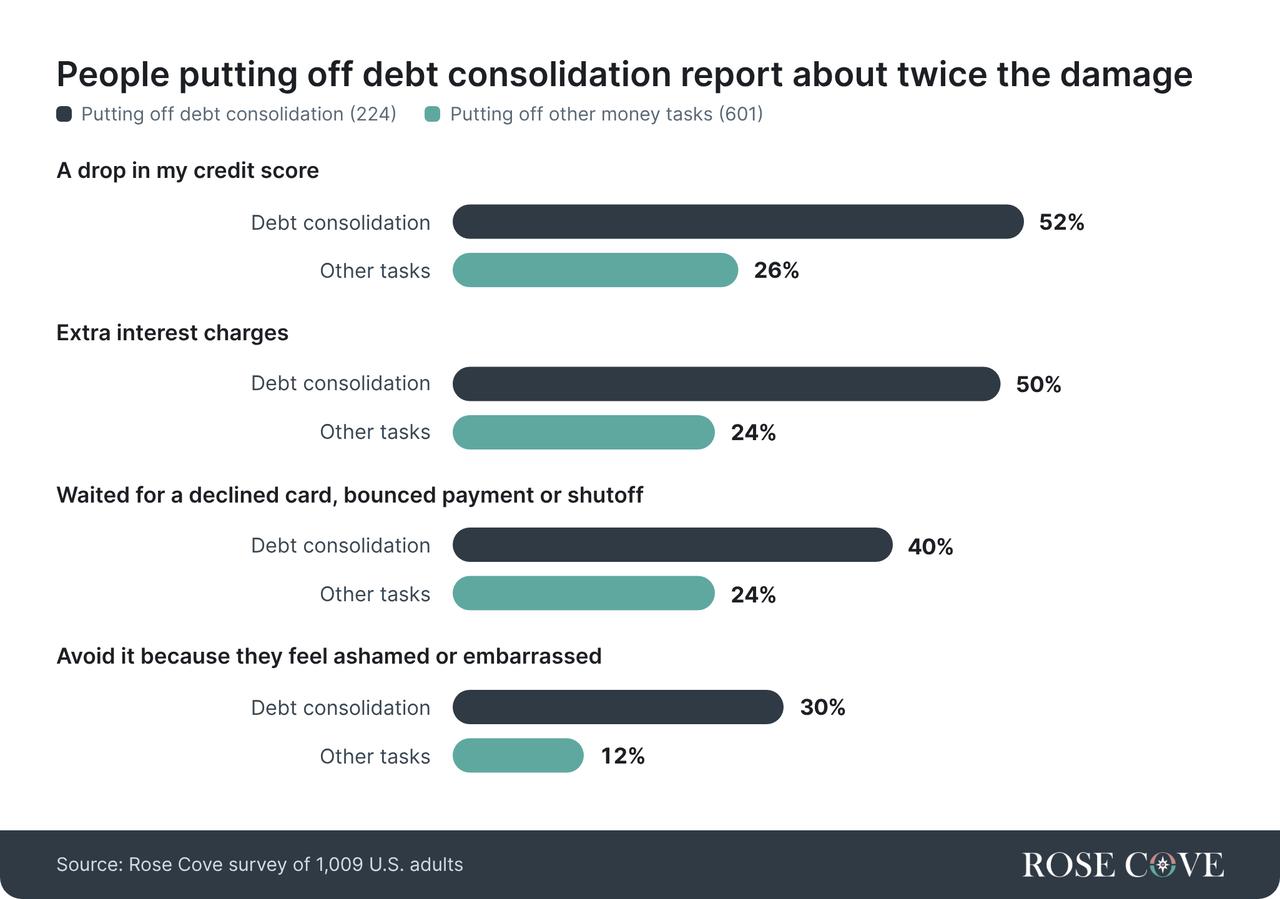
Among people who are putting off debt consolidation, 52% say delaying a money task has led to a drop in their credit score. That is twice the rate of others putting off a money task (26%). Half (50%) report extra interest charges, compared with 24%. They are also more likely to have waited for a crisis (40% vs. 24%) and more than twice as likely to feel ashamed (30% vs. 12%).
That doesn't prove one causes the other. But the pattern is hard to miss, and shame makes it harder to start.
People say they're busy or unsure. Their other answers tell a different story.
Ask people why money tasks sit, and they give reasons that sound reasonable. Look at the rest of their answers, and the picture changes.
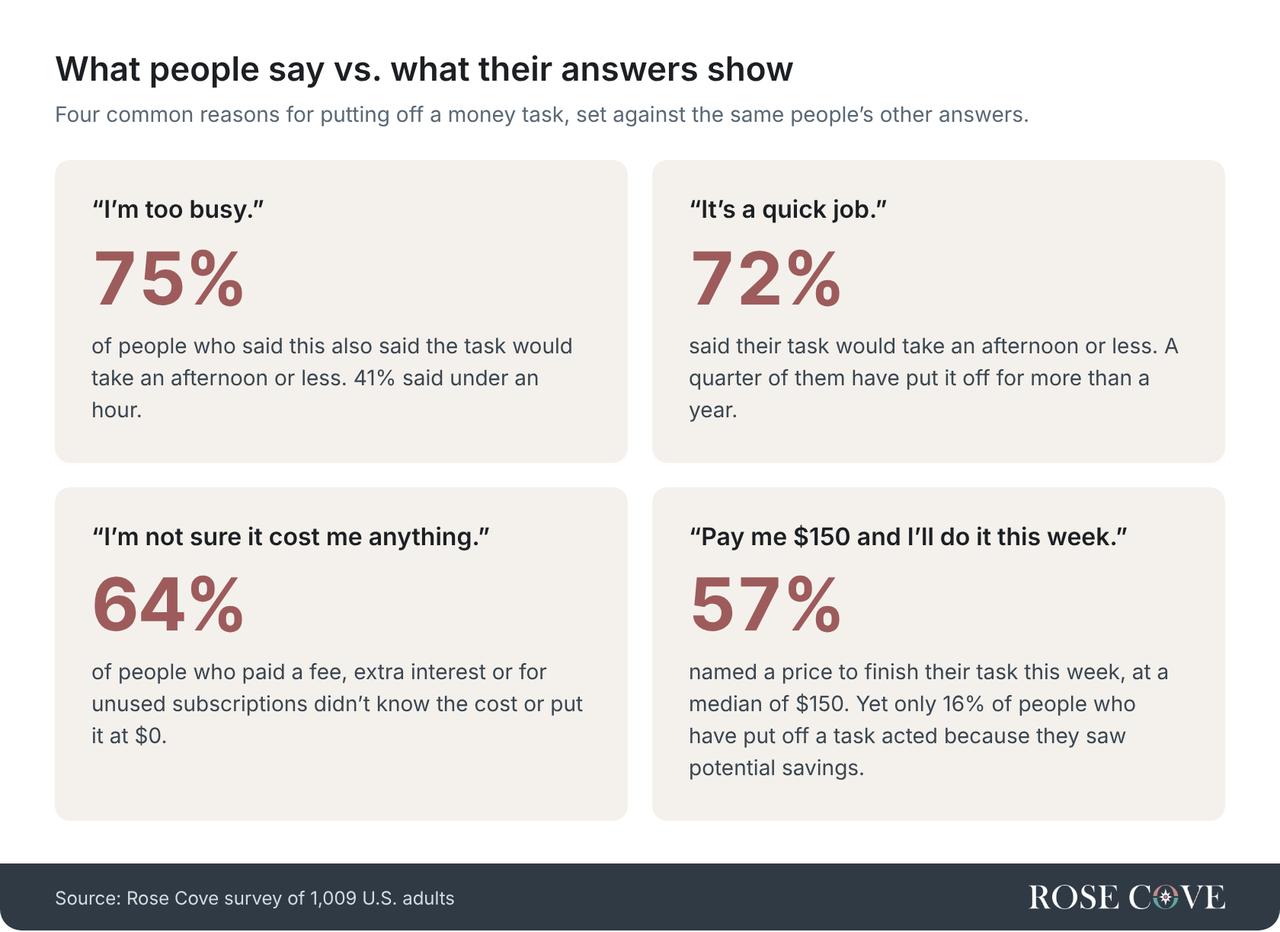
The takeaway isn't that people are careless. Money tasks feel bigger than they are, and the cost stays invisible until something forces the issue.
6 in 10 acted only when something forced their hand.
Most people don't act on a money task until a problem makes them. And when help is offered, most still want the final say.
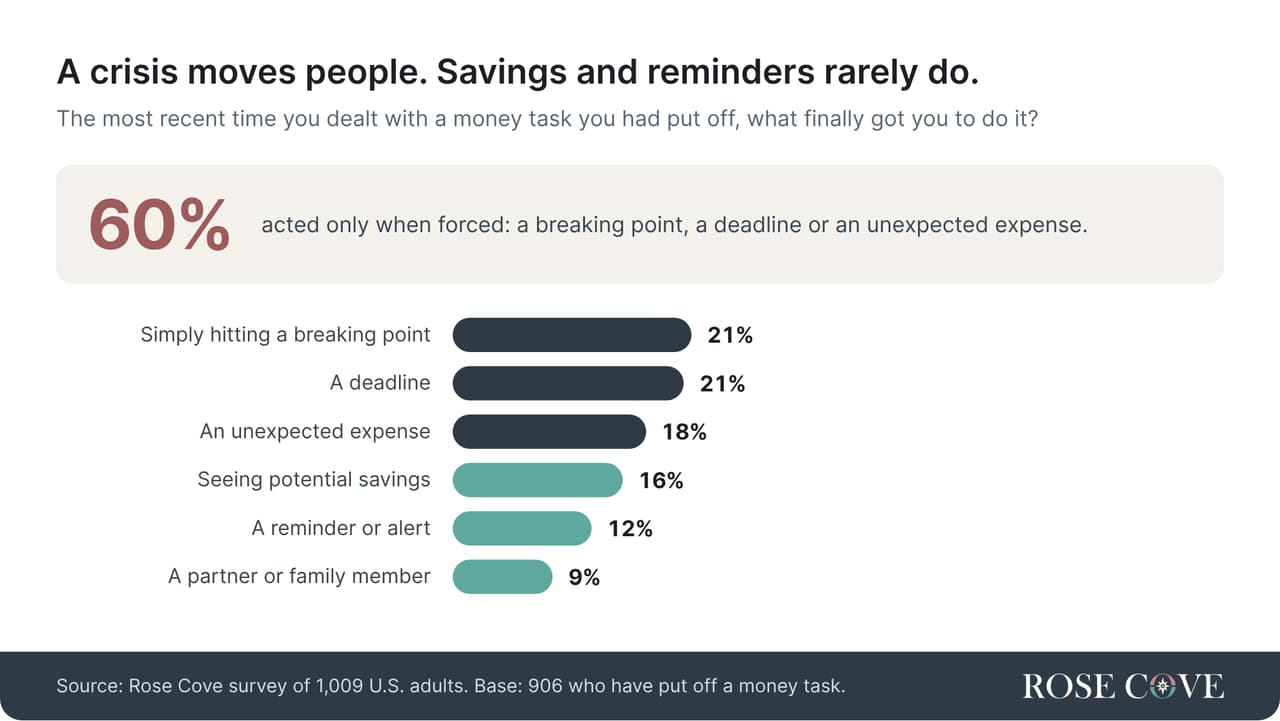
For most, a crisis is the wake-up call. 60% of people who have put off a money task finally dealt with it because of a breaking point, a deadline, or an unexpected expense. Only 16% acted because they saw potential savings, and 12% because of a reminder.
Nearly 1 in 4 (24%) have waited until a card was declined, a payment bounced, or a service was shut off to deal with a money problem they already knew about. They saw it coming. They waited anyway.
Big life moments do the same job. Losing a job tops the list of moments that would make people face their finances (56%), followed by a health scare (37%) and moving (34%).
People want help, on their terms.
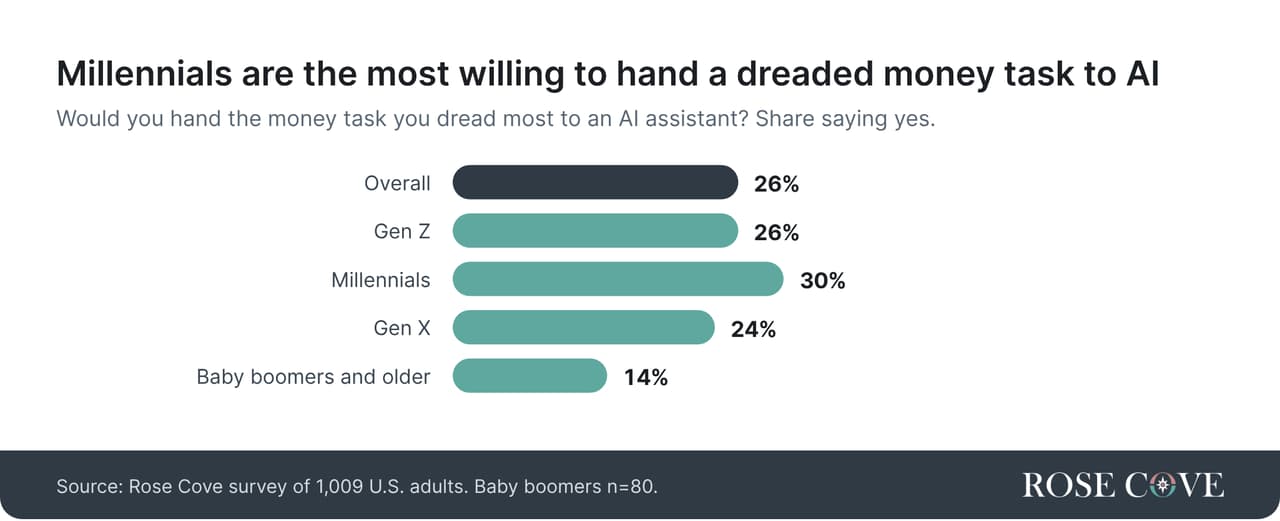
About 1 in 4 (26%) would hand their most dreaded money task to AI. The people who need help most are the most open to it: 30% of those putting off a money task would hand it off, compared with 8% of those who aren't. Millennials lead at 30%, and baby boomers trail at 14%.
Most people still want the final say. 66% wouldn't let AI cancel an expense without reviewing the decision first. The 26% who would hand off a task are the exception: 61% of them would let AI act without review. Baby boomers are the most cautious, at 6%, compared with 19% to 23% of younger generations.
People don't need more options. They need a clear next step.
The survey shows where money tasks get stuck. They feel overwhelming, so people don't start. The costs pile up quietly. And for most, it takes a crisis to act. Showing people what they could save isn't enough: 43% of people putting off a task said no amount would get them to finish it this week.
Our last study found that nearly 9 in 10 people with debt had put off a debt decision. The same pattern shows up here across all ages and incomes.
Most people don't want a tool to decide for them. 66% wouldn't let AI cancel an expense without reviewing it first. A good tool makes the next step small and clear, then lets people decide.
Rose Cove starts with your situation. Tell us where you stand, and in under 2 minutes, we show your Next Best Move℠: one clear step with the trade-offs in plain view. You make the final decision.
Methodology
- Basis
- Rose Cove surveyed 1,009 US adults about the money tasks they're putting off.
Rose Cove surveyed 1,009 adults in the United States on October 22, 2026, through Cloud Search Connect about the money tasks they're putting off, why they avoid them, what that delay has cost them, and what finally gets them to act. Results are not weighted. Millennials make up 47% of the sample and baby boomers 8%, so overall results lean toward younger adults.
The gender breakdown was women (55%), men (43%), and non-binary, self-described, or preferring not to answer (2%). By generation: Gen Z (18%), millennials (47%), Gen X (27%), and baby boomers and older (8%, 80 people). Five respondents did not give a valid birth year. Generations are based on birth year: Gen Z, 1997 to 2008; millennials, 1981 to 1996; Gen X, 1965 to 1980; and baby boomers and older, 1964 or earlier. Results for baby boomers are based on 80 people and should be read as directional. By relationship status, 39% are married, 32% are single, 12% live with a partner, 10% are divorced or separated, 6% are in a relationship but not living together, and 2% are widowed.
82% (825 respondents) are currently putting off at least one money task. Questions about their most avoided task, how long they've avoided it, why, how long it would take, and how much they'd need to save to act were asked only of these 825. Results on what finally got people to act exclude the 103 people who said they have never put off a money task (n=906). Dollar amounts are reported as shares and medians. Results rely on respondents' own accounts of their behavior. All percentages are rounded to the nearest whole number, so some totals may not add up to exactly 100%.
About Rose Cove
Rose Cove is a consumer financial guidance platform. Instead of listing products and leaving you to choose, it starts with your situation and shows your Next Best Move℠. Founded by Eric Barba, Rose Cove turns money decisions into clear next steps.
Fair use statement
You are welcome to share these findings and visuals for noncommercial purposes. Please credit Rose Cove and link back to this page so readers can see the full study and methodology.